
It comes down to the seasonings and the stock
Two seasonings are worth knowing by name: mirin and cooking sake.
Under Japan’s Liquor Tax Act, mirin is counted as an alcoholic beverage. It sits in the compound liquor category and is defined as having an alcohol content under 15% by volume (Article 3, item 11). It lives on the seasoning shelf, but the law files it with the drinks.
Stock varies by dish. Some is drawn from dried bonito and kelp, some is simmered from chicken or pork. The name on the menu will not tell you which.
Each dish turns on something different
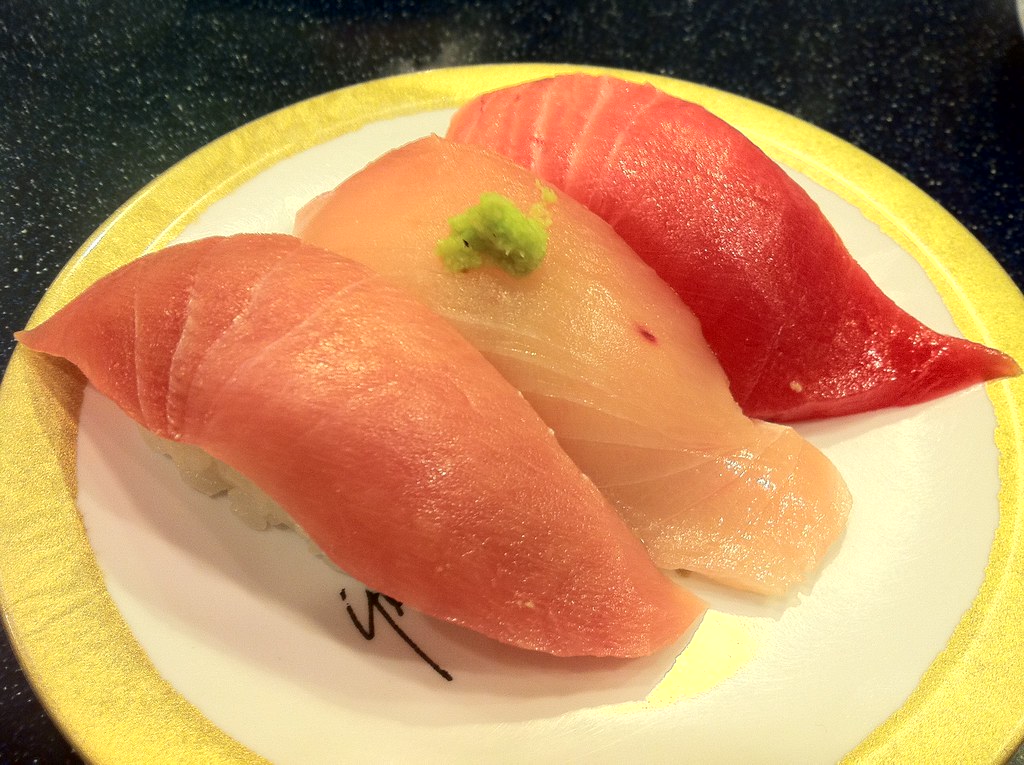
Sushi
Fresh fish is only part of it. Vinegar is mixed into the rice, soy sauce goes on each piece, and gari — ginger pickled in sweet vinegar — clears the palate in between. Every one of those is a seasoning.
Some listed restaurants use certified halal vinegar, soy sauce and miso. One describes every ingredient — soy sauce, vinegar, rice, ginger and meat — as halal.
For the different types of sushi, terms like shari, neta and tsume, and where mirin or sake can come into the vinegar and soy sauce, see our guide to sushi types and terms.
Ramen
This is the dish with the most moving parts. The broth alone ranges across soy sauce, miso, salt, chicken, seafood and beef bone, and the noodles, tare sauce, flavored oil and toppings each reflect the cook’s own choices.
Tonkotsu ramen, which you will see all over Japan, is built on a broth simmered from pork bones. Pork can also turn up in the tare sauce or the chashu topping even when the name says nothing about it. Check whether the listing page shows Pork Free under Conditions.
Two bowls with the same broth can still differ in the tare sauce or the flavored oil. It pays to ask about the bowl in front of you rather than about ramen in general.
For where pork and alcohol can turn up in the broth, the tare, the flavored oil, the chashu and the seasoned egg, see our guide to where pork and alcohol can hide in ramen.
Tempura
The dipping sauce traditionally contains mirin, and the batter and frying oil matter too. Whether the frying oil is kept separate from other dishes is something only the restaurant can tell you.
Other Japanese dishes
Japanese cooking covers a lot of ground: kaiseki courses and kappo cooking, soba and udon, sukiyaki, seafood bowls, tofu and Buddhist vegetarian dishes. One listed sukiyaki specialist explains that its warishita sauce is made without mirin or cooking sake.
Read the Conditions on the listing page
Every listing page carries a Conditions section showing which of the following apply to that restaurant.
- Halal Certified
- Halal Meat
- Pork Free
- Halal Seasoning
- Halal Meal
- No Alcoholic Drinks
- Halal Kitchen & Tableware
- Prayer Space
The list is different for every restaurant. Some show all eight, others show four. What matters is which ones are there and which ones are not.
Below the Conditions you will find the restaurant’s own description. Some spell out how far it goes — one writes that the whole kitchen excludes pork, lard and alcohol. Read the two together and the picture fills in.
What to ask at the restaurant
If anything is still unclear after you have read the listing page, ask. Questions about specific ingredients get clearer answers than questions about a dish.
- What goes into the broth or the stock, and whether any of it comes from pork or contains alcohol
- Whether mirin or cooking sake is used
- Whether the frying oil is separate from other dishes
- Whether cookware and tableware are kept separate
A photo on the menu will not answer any of these.
Browse by cuisine
If you already know what you want to eat, start from the cuisine lists.
Each page also explains what that particular dish turns on. Soba, udon, sukiyaki and seafood bowls sit under Japanese.
Before you set out
Listing details can change without notice. Please check the menu and the current details on the linked page and at the restaurant itself.
Each listing page describes that restaurant’s halal arrangements — certification, ingredients, kitchen practice, and so on. Please read the listing and decide whether the restaurant meets your own standards.
To wrap up
Two restaurants can serve the same dish and part ways once you reach the seasonings and the stock. The Conditions section sets out those differences, restaurant by restaurant.
If you have a dish in mind, the cuisine list is the quickest place to start. If you are planning food and prayer together, we also have an area-by-area guide to prayer spaces in Tokyo.
Image credits
This article was written by the Halal Gourmet Japan team. On Halal Gourmet Japan, you can search for halal-friendly restaurants and prayer spaces all over Japan. The service is also available as an app (iOS / Android).

After seeing his Muslim friends struggle to dine out in Japan, he founded Halal Gourmet Japan, a restaurant search service for Muslims, and has been running it for more than a decade since its launch in 2014. He also co-founded Food Diversity Inc. (formerly Halal Media Japan; he has since stepped down), and has deep expertise in halal support for restaurants and Muslim-oriented inbound tourism. Halal Gourmet Japan is one of Japan’s largest halal-friendly restaurant search services, used in more than 140 countries, introducing halal-friendly restaurants and prayer spaces across Japan in multiple languages.
