
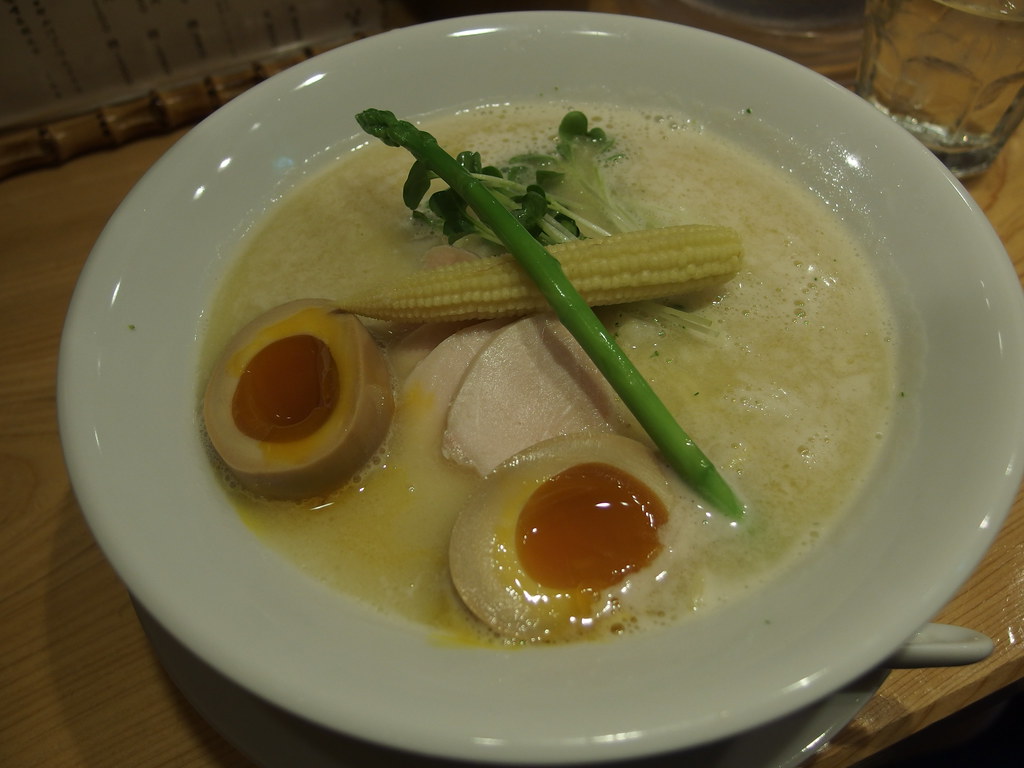
Tonkotsu ramen tells you up front that the broth is made from pork. The harder part is everything the name leaves out. The tare, the flavored oil, the chashu and the seasoned egg can all involve pork or alcohol.
This article walks through where pork and alcohol can turn up in a bowl of ramen, and what to look for on a Halal Gourmet Japan listing page.
Tonkotsu is a broth made from pork bones
Tonkotsu broth is made by simmering pork bones for hours, or cooking them under high pressure, until the bones release their flavor and the liquid turns rich and milky white.
Ramen names follow a pattern that is easy to miss. Shoyu (soy sauce), shio (salt) and miso name the tare, the seasoning base. Tonkotsu names the broth. So a bowl called “shoyu ramen” tells you nothing about what the broth is made from. Shoyu, shio and miso ramen can all be made with pork bone broth, and some broths blend chicken and pork bones. A bowl can contain pork bone broth without “tonkotsu” appearing anywhere on the menu.
Four places the name won’t tell you about
Besides the broth, a bowl of ramen is built from the tare, the flavored oil, the noodles and the toppings. Of these, the tare, the oil and two toppings — the chashu and the seasoned egg — can bring in pork or alcohol without the name giving it away.
Tare
Tare, also called kaeshi, is the concentrated seasoning that goes into the bottom of the bowl before the broth is poured over it. It starts from soy sauce, salt or miso, and may be blended with sugar, mirin, sake and other seasonings, as well as meat extracts.
Under Japan’s Liquor Tax Act, mirin is classified as an alcoholic beverage. Our guide to what to check before ordering Japan’s best-known dishes explains this in more detail.
Flavored oil
The layer of oil floating on the surface adds body and deepens the flavor. Common choices include lard, pork back fat, chicken fat known as chiyu, scallion oil and sesame oil. A bowl with no pork in the broth can still have an oil made from pork fat.
Chashu
Most chashu on Japanese ramen is braised pork: belly, leg or shoulder simmered in a soy-based liquid. Some restaurants also use that braising liquid in their broth or tare.
Halal-friendly ramen restaurants may use chicken or beef instead of pork. Among our listings, some serve chicken chashu, and others top their ramen with halal wagyu. For ramen restaurants in Osaka and Kyoto, see our guide to eating in Osaka and Kyoto.
Seasoned egg
Ajitama, the seasoned egg, is a boiled egg marinated in a soy-based liquid. Some restaurants marinate it in the chashu’s braising liquid, so the liquid from the pork ends up in the egg as well.
Broths made without pork
Other broths are built on chicken bones or whole chickens, seafood, or beef bones and sinew.
You cannot always tell from how a broth looks or what it is called, though. Tori paitan, a chicken broth simmered until it turns cloudy, looks very much like tonkotsu, and some broths sold as tori paitan also use pork bones or seafood.
The tare, the oil and the chashu are also made separately from the broth, so a pork-free broth is not the whole story. Check each bowl on its own rather than going by the type of broth.
What to look for on the listing page
In the Conditions section of each listing page, these four items are the most useful when you are choosing ramen.
- Pork Free
- Halal Meat
- Halal Seasoning
- No Alcoholic Drinks
As the name says, No Alcoholic Drinks means the restaurant does not serve alcohol. For mirin or sake in the tare or the egg, check whether Halal Seasoning is listed, and read the restaurant’s own description below the Conditions section.
Some listings do not show a Conditions section at all. In that case, read the restaurant’s description and check anything unclear with the restaurant.
Some listed restaurants say in their description that the flavored oil is made with rice oil instead of lard, and others say the whole kitchen is free of pork, lard and alcohol.
What to ask at the restaurant
If anything is still unclear after reading the listing page, ask the restaurant. Questions about specific ingredients get clearer answers than questions about a dish.
- Whether the broth uses pork bones or pork
- Whether the tare contains mirin or sake
- Whether the flavored oil is lard or back fat
- What meat the chashu is made from
- What the egg is marinated in
Find ramen restaurants
Our ramen page lists every ramen restaurant on Halal Gourmet Japan, and gives an overview of the listed restaurants in regions such as Hokkaido, Kyoto, Nara and Tokyo.
Before you set out
Listing details can change without notice. Please check the menu and the current details on the linked page and at the restaurant itself.
Each listing page describes that restaurant’s halal arrangements — certification, ingredients, kitchen practice, and so on. Please read the listing and decide whether the restaurant meets your own standards.
To wrap up
A ramen name usually tells you about the broth or the tare, rarely both. Even a name that covers both, like tonkotsu shoyu, says nothing about the oil or the toppings.
For whatever the name leaves out, read the Conditions section and the restaurant’s description first, then ask about what is still unclear. For sushi, tempura and other Japanese staples, see our guide to what to check before ordering Japan’s best-known dishes.
Image credits
This article was written by the Halal Gourmet Japan team. On Halal Gourmet Japan, you can search for halal-friendly restaurants and prayer spaces all over Japan. The service is also available as an app (iOS / Android).

After seeing his Muslim friends struggle to dine out in Japan, he founded Halal Gourmet Japan, a restaurant search service for Muslims, and has been running it for more than a decade since its launch in 2014. He also co-founded Food Diversity Inc. (formerly Halal Media Japan; he has since stepped down), and has deep expertise in halal support for restaurants and Muslim-oriented inbound tourism. Halal Gourmet Japan is one of Japan’s largest halal-friendly restaurant search services, used in more than 140 countries, introducing halal-friendly restaurants and prayer spaces across Japan in multiple languages.
