
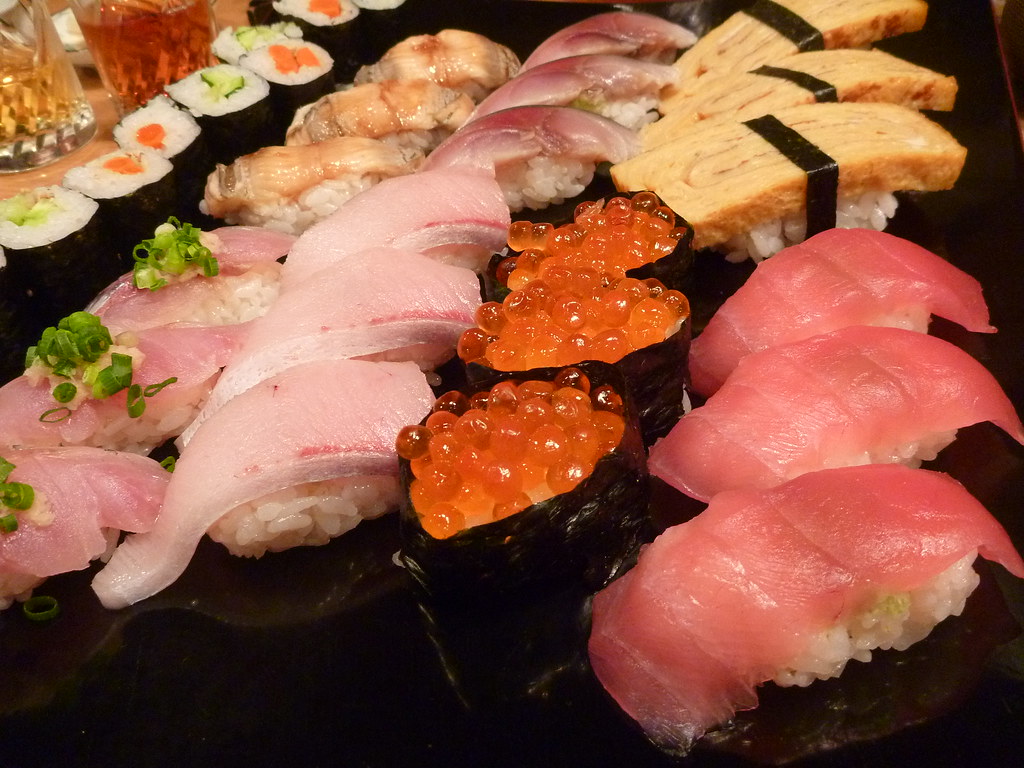
A sushi menu in Japan lists nigiri, gunkan and chirashi side by side, and at the counter you will hear words like shari, neta, gari and tsume.
This article explains the main types of sushi and the terms you are likely to hear. It also covers where alcohol can come into sushi through the seasonings, and what to look for on a Halal Gourmet Japan listing page.
The main types of sushi
All of them use vinegared rice. What sets them apart is the shape and how they are put together.
- Nigiri — a small, hand-pressed mound of rice topped with fish or another ingredient. This is the style most people picture when they think of sushi, and it is also called Edomae sushi.
- Maki — rice and fillings rolled in nori seaweed. The nori usually goes on the outside, but inside-out rolls put the rice on the outside instead.
- Gunkan — a strip of nori wrapped around the rice to form a low wall, with the topping heaped inside. It is used for toppings such as salmon roe and sea urchin that would fall apart on a nigiri.
- Chirashi — vinegared rice scattered with seafood and seasonal ingredients, often served at celebrations such as the Doll Festival.
- Oshizushi — rice and toppings packed into a mold and pressed. Osaka’s hakozushi, or box sushi, is the best-known example.
- Inari — rice stuffed into a pouch of sweet-savory simmered fried tofu. In Kanto it is usually shaped like a rice bale, while in Kansai it is more often triangular.
Words you will hear at a sushi restaurant
On a nigiri, the rice is called shari and whatever goes on top is the neta. Shari is made by mixing cooked rice with awasezu, vinegar with sugar and salt dissolved in it. Neta is mostly seafood, but it can also be something like rolled omelet.
The ginger served alongside is gari, thin slices of ginger pickled in sweet vinegar and eaten between pieces to refresh your palate. It is pale beige and should not be confused with beni shoga, the red ginger pickled in plum vinegar that is served with beef bowls.
Seasonings where alcohol can come in
Sushi gets its flavor from the seasonings as much as from the fish, and some of them are made with mirin, sake or sake lees. Under Japan’s Liquor Tax Act, mirin is classified as an alcoholic beverage.
Vinegar
The vinegar in the rice may be rice vinegar, or kasuzu, a vinegar made from sake lees — the solids left over after sake is pressed. Kasuzu made from aged sake lees has a reddish color, which is why it is called akazu (red vinegar). It is used mainly for sushi rice.
Nikiri
Nikiri is the technique of boiling mirin or sake to cook off the alcohol, and also the name for the liquid it produces. Some sushi restaurants serve nikiri soy sauce instead of plain soy sauce: soy sauce combined with mirin or sake boiled this way.
Tsume
Tsume, short for nitsume, is a thick, sweet-savory glaze made by reducing the liquid used to simmer conger eel and similar ingredients and adding soy sauce, sugar, mirin, sake and other seasonings. It is brushed onto conger eel and shellfish nigiri.
What to look for on the listing page
In the Conditions section of each listing page, the item that matters for sushi seasonings is Halal Seasoning. Check whether it is listed, and read the restaurant’s own description below the Conditions section.
Some listings do not show a Conditions section at all. In that case, read the restaurant’s description and check anything unclear with the restaurant.
Some listed restaurants use certified halal vinegar, soy sauce and miso. One describes every ingredient — soy sauce, vinegar, rice, gari and meat — as halal.
What to ask at the restaurant
If anything is still unclear after reading the listing page, ask the restaurant.
- Which vinegar goes into the rice
- Whether they use nikiri soy sauce made with mirin or sake
- Whether tsume is used on the conger eel or shellfish
- What goes into the sweet vinegar for the gari
Find sushi restaurants
Our sushi page lists every sushi restaurant on Halal Gourmet Japan, and also explains why the seasonings matter when choosing sushi.
For ramen, tempura and other Japanese staples, see our guide to what to check before ordering Japan’s best-known dishes.
Before you set out
Listing details can change without notice. Please check the menu and the current details on the linked page and at the restaurant itself.
Each listing page describes that restaurant’s halal arrangements — certification, ingredients, kitchen practice, and so on. Please read the listing and decide whether the restaurant meets your own standards.
To wrap up
Sushi comes in many shapes, but every one of them rests on the rice and the seasonings. The same piece of fish can end up quite different depending on whether the rice is seasoned with akazu, whether nikiri soy sauce is used and whether tsume goes on top.
Once you know the words, your questions at the counter get more specific. Start with the Conditions section and the restaurant’s description, then ask about anything you are still unsure of.
Image credits
This article was written by the Halal Gourmet Japan team. On Halal Gourmet Japan, you can search for halal-friendly restaurants and prayer spaces all over Japan. The service is also available as an app (iOS / Android).

After seeing his Muslim friends struggle to dine out in Japan, he founded Halal Gourmet Japan, a restaurant search service for Muslims, and has been running it for more than a decade since its launch in 2014. He also co-founded Food Diversity Inc. (formerly Halal Media Japan; he has since stepped down), and has deep expertise in halal support for restaurants and Muslim-oriented inbound tourism. Halal Gourmet Japan is one of Japan’s largest halal-friendly restaurant search services, used in more than 140 countries, introducing halal-friendly restaurants and prayer spaces across Japan in multiple languages.
