
Few food products in Japan carry any halal labelling. When you pick up a pack of biscuits or a loaf of bread, the ingredients list on the back is what you have to go on.
But that list is full of words like “shortening”, “emulsifier” and “gelatin”, which do not tell you what they were made from. This guide explains how to read the words that often appear on Japanese snack and bread labels, and what to do when the label does not answer your question.
The slash separates ingredients from additives
According to the Consumer Affairs Agency’s guide to food labels (PDF, in Japanese), ingredients and additives are each listed in order of quantity, largest first.
When both appear in the same “原材料名” (ingredients) field, they are separated by a slash (/) or a line break. Some products have a separate “添加物” (additives) field instead.
So if a label reads “小麦粉、砂糖、ショートニング/乳化剤、香料” (wheat flour, sugar, shortening / emulsifier, flavouring), everything before the slash is an ingredient and everything after it is an additive.
Shortening (ショートニング), margarine (マーガリン) and lard (ラード)
Japan’s agricultural standard (JAS) for shortening defines it as a solid or liquid product made from “edible fats and oils” and processed to make it easier to work with.
When the same standard explains how to list the ingredients of shortening sold to businesses, it gives “soybean oil” and “pork fat” (豚脂) as examples. In other words, shortening can be made from plant oils or from animal fats such as pork fat.
Lard is pork fat. The JAS standard for refined lard defines it as refined pork fat, or a product made mainly from it.
The standard for margarine defines it as edible fats and oils emulsified with water and other ingredients. The name alone does not tell you which fats were used.
Shortening and margarine are themselves made from several ingredients, which makes them “compound ingredients”. Osaka Prefecture’s guide to ingredient labelling (in Japanese) explains that the breakdown of a compound ingredient can be left out, for example when it makes up less than 5% of the product.
If a label just says “ショートニング”, it may not tell you whether the fat came from plants or animals.
Emulsifiers (乳化剤), flavouring (香料) and other group names
Some additives can be listed under a group name instead of the name of the specific substance.
Osaka Prefecture’s guide to additive labelling (in Japanese) lists 14 of these group names, including emulsifier (乳化剤), flavouring (香料), leavening agent (膨張剤) and yeast food (イーストフード). The sample label for Western-style confectionery in the Consumer Affairs Agency’s guide also lists leavening agent, flavouring and emulsifier.
When a group name is used, the label does not show which substance was actually added. A Consumer Affairs Agency document (in Japanese) gives lecithin and glycerin fatty acid esters as examples of additives that can be listed simply as “emulsifier”.
Glycerin fatty acid esters are emulsifiers made from fats and oils. The European Food Safety Authority’s opinion on these emulsifiers (E 471) lists tallow and lard among the possible source materials, alongside plant oils such as soy and palm.
You may also see something like “乳化剤(大豆由来)” (emulsifier, derived from soy). This is an allergen label telling you that the product contains soy.
Gelatin (ゼラチン)
Gelatin is made by extracting collagen from bones, skin and similar materials. The Japan Gelatine and Collagen Manufacturers Association’s hygiene manual (in Japanese) explains that it is made from the bones, skin and scales of cattle, pigs and fish.
If a label just says “ゼラチン”, it does not tell you whether the gelatin came from cattle, pigs or fish.
Western liquor (洋酒)
“洋酒” (yōshu) is a general term for Western-style liquors such as brandy and rum. The sample label for Western-style confectionery in the Consumer Affairs Agency’s guide lists “洋酒” as one of the ingredients.
If you see “洋酒” in the ingredients, the product is made with alcohol.
What allergen labels can and cannot tell you
At the end of the ingredients list, you may see something like “(一部に小麦・卵・乳成分を含む)” (contains wheat, egg and milk). This is the allergen label.
According to a Consumer Affairs Agency document from May 2026 (in Japanese), nine items must be labelled, including shrimp, crab, wheat, buckwheat, egg and milk. Pork (豚肉), beef (牛肉) and gelatin (ゼラチン) are among the 20 items for which labelling is only recommended.
So if “豚肉” or “ゼラチン” is not in the allergen label, that does not mean the product is free of them. Labelling either is optional, so some products leave them out.
Bread from a bakery may have no label
Osaka Prefecture’s guide to processed food labelling (in Japanese) explains that food sold where it was made does not need to list its ingredients.
Bread baked and sold in the same shop may come without an ingredients list. If you want to know, ask the staff what goes into it.
How to check when the label does not tell you
First, look for a halal certification mark on the package. If there is one, check which certification body issued it, so you can compare it with your own standards.
If the label does not answer your question, you can contact the manufacturer or seller named on the package. Asking specifically about the ingredients they use tends to get a clearer answer.
- Is the fat in the shortening or margarine from plants or animals?
- What fat is used to make the emulsifier?
- Is the gelatin from cattle, pigs or fish?
- Do the flavourings contain alcohol?
At a bakery, you can also show the staff our note in Japanese.
Scan the label with Halal Lens
The Halal Gourmet Japan app has a feature called Halal Lens. Scan a product’s barcode or ingredients list, and it gives a three-level result for ingredients you may want to avoid.
It helps when a Japanese ingredients list is hard to read word by word.
The three levels and how to use the feature are explained in What is Halal Lens?.
Buy from a halal grocer
If there is a halal grocer nearby, you can also look for snacks and bread there. Halal Gourmet Japan lists halal grocers, sweet shops and other retailers on its Store page.
Our guide to where to buy halal food in Japan explains how to find them. For gifts, see Discover the Halal Corner at Don Quijote Shinjuku.
Before you buy
Ingredients can change even when the product name stays the same. Please check the label on the product you are buying.
Each shop’s listing on Halal Gourmet Japan shows its halal details, such as certification. Please read the label and the listing, and decide whether they meet your own standards.
The same goes for Halal Lens results: the final decision is yours.
To wrap up
Snack and bread labels in Japan often include words like shortening, emulsifier and gelatin that do not say what they were made from. When you spot one, look for a certification mark, ask the manufacturer or the shop, or scan the label with Halal Lens.
If you are a Muslim shopper in Japan and are not sure where to look on a snack or bread label, this is the place to start.
Image credits
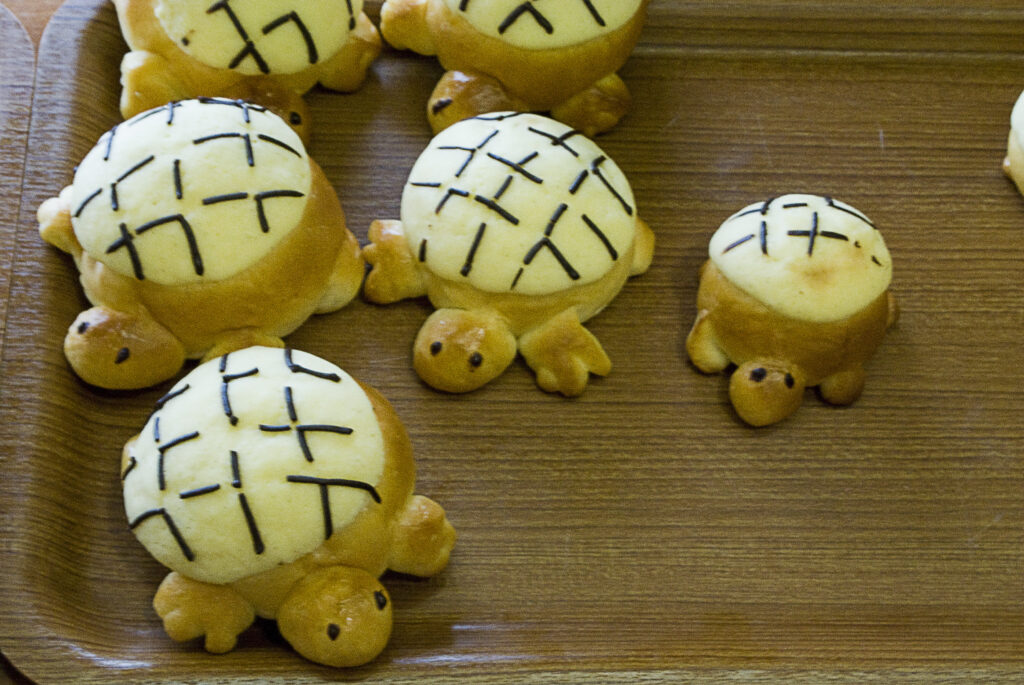
- Featured image (turtle-shaped sweet buns): buyalex / CC BY 2.0 / Wikimedia Commons
This article was written by the Halal Gourmet Japan team. On Halal Gourmet Japan, you can search for halal-friendly restaurants and prayer spaces all over Japan. The service is also available as an app (iOS / Android).
After seeing his Muslim friends struggle to dine out in Japan, he founded Halal Gourmet Japan, a restaurant search service for Muslims, and has been running it for more than a decade since its launch in 2014. He also co-founded Food Diversity Inc. (formerly Halal Media Japan; he has since stepped down), and has deep expertise in halal support for restaurants and Muslim-oriented inbound tourism. Halal Gourmet Japan is one of Japan’s largest halal-friendly restaurant search services, used in more than 140 countries, introducing halal-friendly restaurants and prayer spaces across Japan in multiple languages.

