
At restaurants in Japan, the menu does not always say whether a dish contains pork or alcohol. And when you try to ask, the staff may not speak English.
This article gives you a short note in Japanese that tells restaurant staff you are Muslim and cannot eat pork or drink alcohol, and asks them to watch out for alcohol in seasonings too. Open this page on your phone and show it to the staff, or save the note as a screenshot so you can show it before you order.
The note to show restaurant staff
【お店の方へ】
私はムスリム(イスラム教徒)です。
宗教上の理由で、豚肉と、豚由来のもの(ラード、豚骨スープ、ハム、ベーコンなど)を食べることができません。
お酒も飲むことができません。
もし可能でしたら、アルコールが添加された醤油や、みりん、料理酒などの調味料を使わずにお作りいただけないでしょうか。
対応が難しい場合は、遠慮なくお知らせください。
どうぞよろしくお願いいたします。
What the note says
To the restaurant staff:
I am Muslim.
For religious reasons, I cannot eat pork or anything derived from pork (such as lard, pork bone broth, ham or bacon).
I also cannot drink alcohol.
If possible, could you please prepare my food without seasonings such as soy sauce with added alcohol, mirin and cooking sake?
If this is difficult, please feel free to tell me.
Thank you very much.
What the note covers
Pork is not always served as a piece of meat. It can also go into a dish as lard, pork bone broth, ham or bacon. Even if you have not ordered a pork dish, it may be in the soup or the cooking oil, so the note gives examples to make this clear to the staff. For where pork tends to turn up in ramen, see our guide to where pork and alcohol can hide in ramen.
The line about seasonings is especially important for Japanese food. Some soy sauces have alcohol added as an ingredient. Mirin and cooking sake are also common in Japanese cooking. For the types of mirin and how Japan’s Liquor Tax Act treats them, see our guide to what to check before you order.
Not every restaurant can change all of its seasonings, so the note asks “if possible.” If the staff say it is difficult, you can choose another dish or look for another restaurant.
Understanding the staff’s answer
When you show the note, the staff may answer in Japanese. Here are three replies you might hear.
- 大丈夫です (daijōbu desu) — That’s fine, we can do that
- 確認します (kakunin shimasu) — I’ll check
- 難しいです (muzukashii desu) — That’s difficult for us
Before you go
This note is a way to tell restaurant staff what you are asking for. What each restaurant can do differs, and the answer you get reflects that restaurant’s own judgment.
Each Halal Gourmet Japan listing page describes the restaurant’s halal arrangements (certification, ingredients, kitchen, and so on). Based on the listing and the staff’s answer, please decide whether the restaurant meets your own standards.
When you buy food at a convenience store or supermarket, you can also use Halal Gourmet Japan’s Halal Lens, which checks a product by scanning its barcode or ingredient label with your phone.
To wrap up
Even if you do not speak Japanese, showing this note lets restaurant staff know what you need them to watch out for. If you save the note as a screenshot, you can show it even when you have a weak signal. To find listed restaurants near where you are going, search on Halal Gourmet Japan.
Image credits
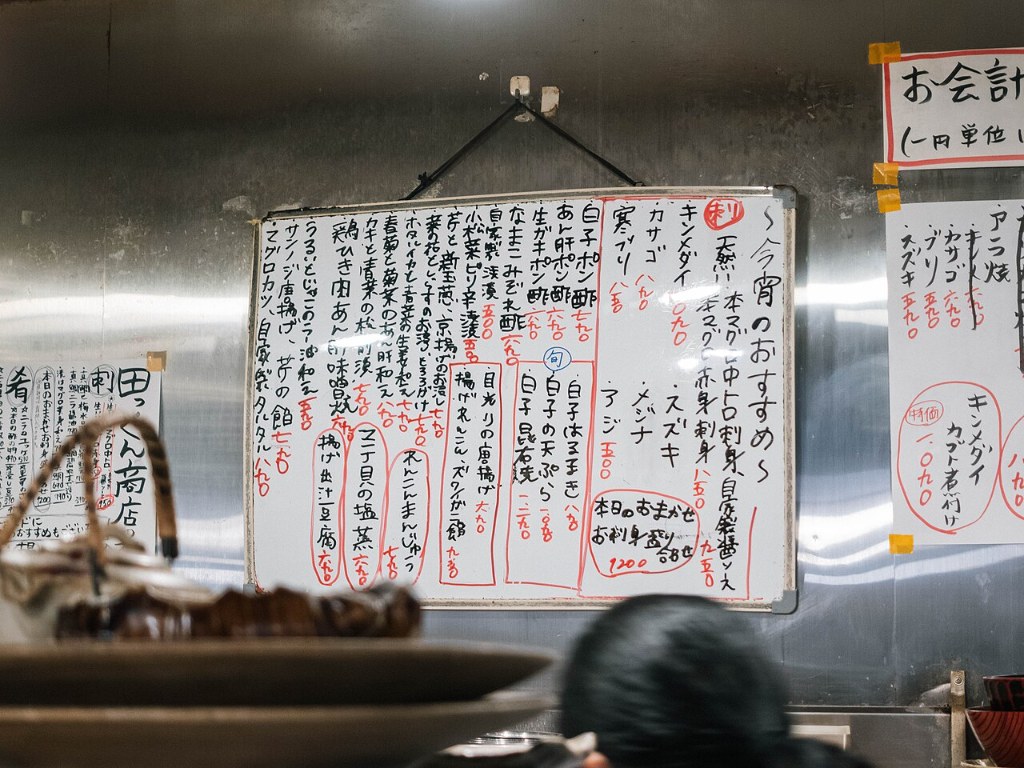
- Featured image (a handwritten menu at an izakaya): Ryohei Noda from Tokyo, Japan / CC BY 4.0 / Wikimedia Commons
This article was written by the Halal Gourmet Japan team. On Halal Gourmet Japan, you can search for halal-friendly restaurants and prayer spaces all over Japan. The service is also available as an app (iOS / Android).

After seeing his Muslim friends struggle to dine out in Japan, he founded Halal Gourmet Japan, a restaurant search service for Muslims, and has been running it for more than a decade since its launch in 2014. He also co-founded Food Diversity Inc. (formerly Halal Media Japan; he has since stepped down), and has deep expertise in halal support for restaurants and Muslim-oriented inbound tourism. Halal Gourmet Japan is one of Japan’s largest halal-friendly restaurant search services, used in more than 140 countries, introducing halal-friendly restaurants and prayer spaces across Japan in multiple languages.

