
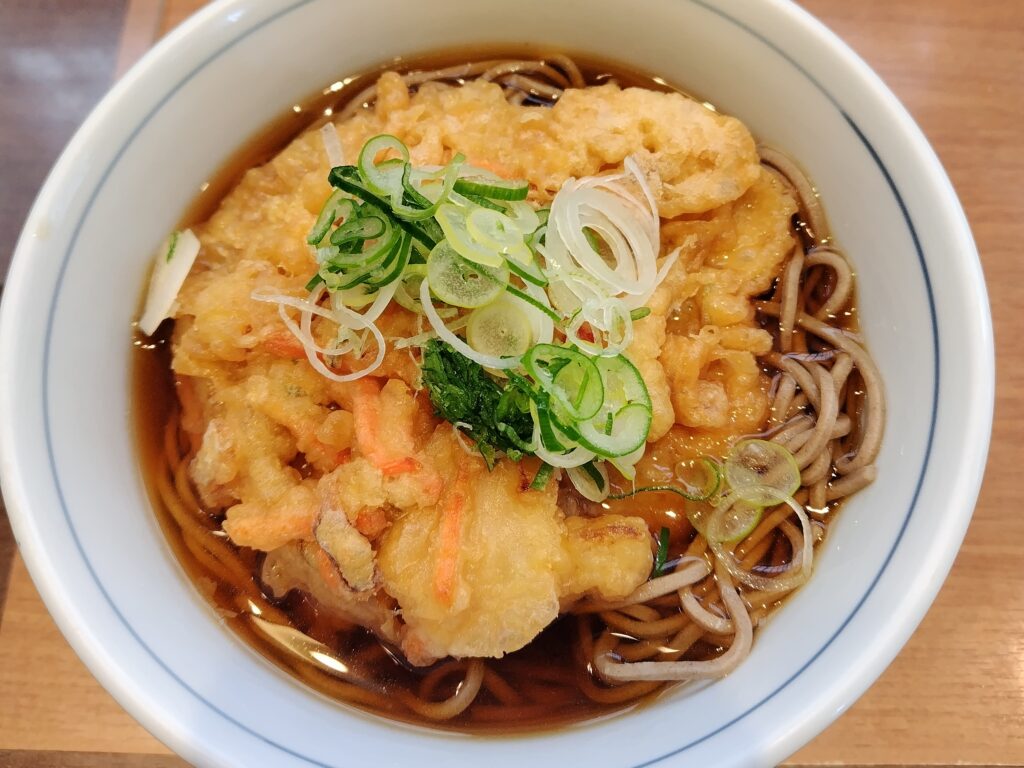
Tempura, soba and udon look like dishes made without meat. But the parts worth checking do not appear in their names: mirin in the dipping sauce and broth, what the dashi stock is made from, the oil used for frying tempura and any meat used as a topping.
This guide explains where alcohol or pork may be used in tempura, soba and udon, what to look for on a Halal Gourmet Japan listing page, and what to ask at the restaurant. At the end, we introduce restaurants whose listing pages show their halal arrangements.
The dipping sauce and broth can contain mirin
The dipping sauce and broth for soba and udon are made by combining kaeshi, a soy sauce base, with dashi. A page introducing Japanese food from Japan’s Ministry of Agriculture, Forestry and Fisheries describes kaeshi for soba dipping sauce as soy sauce, sugar and hon-mirin mixed in a ratio of 5:1:1. Tentsuyu, the dipping sauce for tempura, also often contains mirin.
Hon-mirin is classified as an alcoholic beverage under Japan’s Liquor Tax Act. For the differences between types of mirin, see our guide to what to check before you order Japanese food.
Dashi varies by restaurant
The same ministry page describes making dashi for soba dipping sauce by simmering shaved bonito and mackerel flakes. However, what goes into dashi varies by restaurant, and some dishes use stock made from chicken or pork. You cannot tell from the name of a dish, so ask the restaurant if you are unsure.
You cannot tell the tempura frying oil by looking
Tempura is vegetables or seafood coated in batter and deep-fried. It also appears in other dishes, such as tendon (tempura rice bowl), tempura soba and tempura udon. You cannot tell by looking whether the tempura is fried in the same oil as pork dishes such as tonkatsu.
Some soba and udon come with meat
Some dishes, such as niku soba, niku udon and curry udon, come with meat, and the name of the dish does not always tell you what meat is used.
What to check on a listing page
Of the “Conditions” on each listing page, these four are useful when choosing tempura, soba or udon:
- Pork-Free
- Serves Halal Meat
- Uses Halal Seasoning
- No Alcoholic Drinks
“No Alcoholic Drinks” means the restaurant does not serve alcohol. For mirin in the dipping sauce and broth, check whether “Uses Halal Seasoning” is shown, and also read the restaurant’s own description below the “Conditions.”
What to ask at the restaurant
If the listing page does not answer your question, ask the restaurant specifically about the ingredients they use:
- Does the dipping sauce or broth contain mirin or sake?
- What is the dashi made from?
- Is the tempura frying oil kept separate from other fried foods?
- What meat is used in the topping?
Restaurants that show their halal arrangements
Halal Gourmet Japan lists five tempura restaurants and nine soba and udon restaurants (as of October 2026). Here are the ones whose listing pages show their halal arrangements.
Tempura
TENDON ITSUKI, in Ginza, Tokyo, specializes in tendon. It has halal certification, and its “Conditions” list halal meat and halal seasonings, pork-free food, no alcoholic drinks, halal options, a dedicated halal kitchen and tableware, and vegetarian options. Our guide to Tendon Ginza Itsuki explains where its two Ginza branches are and how they differ.
Halal Wagyu Ramen & Gyukatsu GYUMON Nara, in Nara, is also listed under tempura. Its description features its halal wagyu ramen. It has a prayer space, and its listing shows that it uses halal meat and halal seasonings, is pork-free, does not serve alcohol, and has halal options, a dedicated halal kitchen and tableware, and vegetarian options.
Soba and udon
Three soba and udon restaurants have halal certification: two Soji-bo branches and Kineya Mugimaru. Sojibou DiverCity Tokyo Plaza is in Aomi, Koto-ku, Tokyo, and Soji-bo Narita international airport Terminal2 is in Terminal 2 of Narita International Airport. Kineya Mugimaru Narita Airport Terminal 1 is in Terminal 1. All three use halal meat and halal seasonings, are pork-free, and have halal options and a dedicated halal kitchen and tableware. We also cover the two Narita International Airport restaurants in our guide to Narita and Haneda Airports.
Komatsu Udon Doujou Tsurutto, in Komatsu, Ishikawa Prefecture, is a showcase shop for Komatsu udon, a regionally registered brand. It has a prayer space, and its “Conditions” list pork-free food, halal seasonings, halal options and vegetarian options. For other places in Komatsu, see our guide to Kanazawa and Komatsu.
Kofune (reservation required), in Takayama, Gifu Prefecture, needs a reservation, as its name says. Its description says you can pray in the building before or after lunch when it is not busy. Its “Conditions” show that it is pork-free, uses halal seasonings, and has vegetarian options.
Ohkute YAMAMOTOYA Sakura-dori Otsu, in Naka-ku, Nagoya, uses halal meat and has halal options, plus a dedicated halal kitchen and tableware. For miso nikomi udon in Nagoya, see our Nagoya guide.
The soba and udon listings also include Michi-no-Eki Urabandai Cafeteria in Kitashiobara, Fukushima Prefecture, and Yossi-Seisakusyo in Komatsu, Ishikawa Prefecture. Both feature ramen in their descriptions, and their listings show halal seasonings, halal options and vegetarian options.
Find tempura, soba and udon restaurants
You can find the restaurants we list on these pages:
Before you go
Information on our listings may change at the restaurant’s discretion. Please check menus and arrangements on the linked pages and with the restaurant on site.
Each listing page describes the restaurant’s halal arrangements (certification, ingredients, kitchen, and so on). Please read the listing and decide whether it meets your own standards. If you want to let staff know that you avoid pork and alcohol, you can show them our note in Japanese.
To wrap up
Tempura, soba and udon do not look like dishes that contain meat. The parts to check are the mirin in the dipping sauce and broth, what the dashi is made from, the tempura frying oil and any meat topping. Reading the “Conditions” and the description on the listing page first helps you narrow down what to ask at the restaurant.
Image credits
- Featured image (tempura soba): 妖精書士 / CC0 / Wikimedia Commons
This article was written by the Halal Gourmet Japan team. On Halal Gourmet Japan, you can search for halal-friendly restaurants and prayer spaces all over Japan. The service is also available as an app (iOS / Android).

After seeing his Muslim friends struggle to dine out in Japan, he founded Halal Gourmet Japan, a restaurant search service for Muslims, and has been running it for more than a decade since its launch in 2014. He also co-founded Food Diversity Inc. (formerly Halal Media Japan; he has since stepped down), and has deep expertise in halal support for restaurants and Muslim-oriented inbound tourism. Halal Gourmet Japan is one of Japan’s largest halal-friendly restaurant search services, used in more than 140 countries, introducing halal-friendly restaurants and prayer spaces across Japan in multiple languages.

